
On Thursday 7 February 2008 the Archbishop of Canterbury, Dr Rowan Williams, gave a lecture at the Royal Courts of Justice. By Friday morning he was on just about every newspaper front page. The Daily Express, the Daily Mail and the rest had him calling for sharia law in Britain. The Sun went with "What a Burkha". And thus, there were calls for his resignation. All this from a lecture on the relationship between civil and religious law, delivered to an audience of lawyers. And the cause? Punishing long sentences. Justice was served.

Public Speaking Always Punishes Long Sentences
Had the Archbishop called for sharia law? No. Had he said anything so simple that a journalist could quote it? Also no. And that was the problem.
Long Sentences Are Punishment
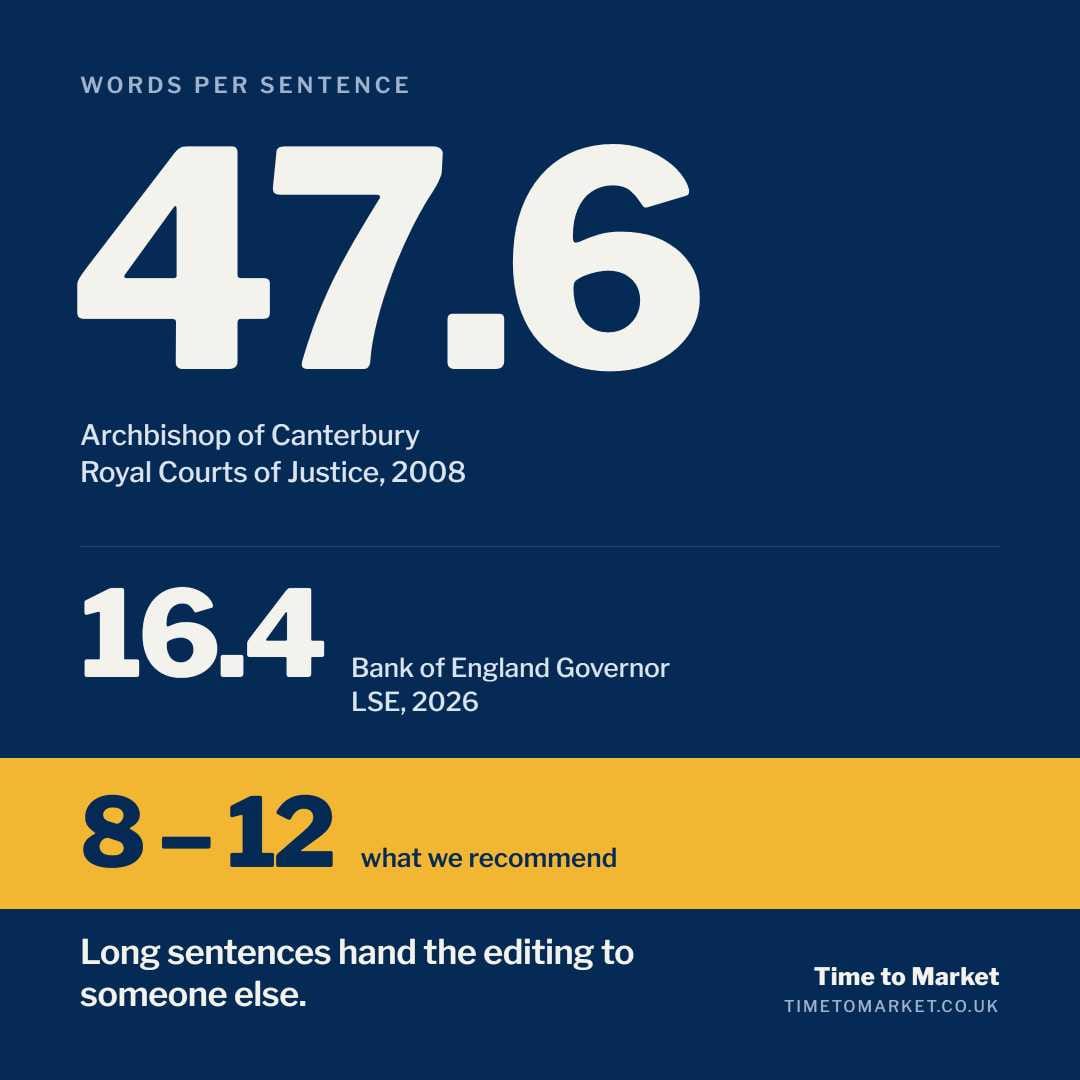
We ran the numbers. The lecture runs to some 6,300 words in 132 sentences. That's an average of 47.6 words per sentence. The median is 47, so this wasn't a few long ones dragging up the average. It was the whole speech. Fifty-seven of his sentences top 50 words. The longest runs to 148, held together by a dash, a colon and two sets of brackets.
The one line the papers did quote, that some accommodation of sharia "seems unavoidable", didn't come from the lecture at all. It came from his Radio 4 interview the same lunchtime. The journalists had 6,000 words they couldn't parse and one soundbite they could. So, they chose the soundbite.
We were reminded of all this ten days ago when the Governor of the Bank of England spoke at the London School of Economics. Andrew Bailey averages a respectable 16 words per sentence, and his median is 13. But he still let two sentences past the 100-word mark, and one of them was a seven-item list read aloud as a single breath. We looked at his title in our last article. His longest sentences deserved a look too!
Don't Punish Your Audience
Here's the point. When your sentences run long, you don't just tire your audience. You hand the editing to someone else. A 47-word sentence has no clause that stands alone, so someone else cuts one out. The qualifications go, and the qualifications were the argument.
On our courses we suggest an average of eight to twelve words per sentence. You'll have your own style, and you need variety, because a speech of nothing but eight-word sentences sounds like a telegram. There's a good example of this variety with the Michael Gove leadership speech epic in 2019. But the average matters, and so do the outliers. Here's how to bring both down.
Top Tips to Avoid Punishing Long Sentences
Tip 1 Count
Take your last speech and count the words in ten sentences at random. Divide by ten. If the answer is over twenty, you're writing for the page, not the ear. You can't fix what you haven't measured.
Tip 2 Full Stop
Find a comma. Ask whether it could be a full stop. It usually can. Here's the Bank of England Governor, at 52 words:
"But it does underline that independence often requires making decisions that do not align with the private interests of any constituency or group, and that at times resisting pressure from the concentrated interests that Mancur Olson identified is part of the task of protecting a public good like the value of money."
And here it is again:
"But it does underline one thing. Independence means decisions that suit no single group. Sometimes it means resisting concentrated interests. That is part of protecting the value of money."
Four sentences, 30 words, same meaning.
Tip 3 ease Out the Conditional
"If X, then Y, unless Z" is fine on paper because the reader can look back. Your listener can't. By the time you reach the "unless", they've already accepted the "then". The Archbishop's lecture is full of these, and they're exactly what got lost between the lectern and the front page.
So, give the condition its own sentence. "There is one exception. It's this…"
Tip 4 Change Gear
Short sentences land. Long sentences flow. You need both. Follow a twenty-word sentence with a five-word one. Because the contrast is what makes the short one hit, and it gives your audience a place to breathe.
Tip 5 Leave a Quote
Somewhere in your speech there should be a sentence that can be lifted out whole and lose nothing. Write it on purpose. If you don't give the journalists a sentence to quote, they'll make one for you. Ask Dr Williams.
None of this makes you sound simple. It makes you sound clear. The Archbishop had a subtle argument and nobody heard it. Short sentences would have carried it further than long ones ever could. Because long sentences might well work in your Word document. But not in your speech So, avoid the hassle of punishing long sentences.
The Case for Shorter Sentences
It's no stretch to say that long sentences in a speech are a punishment. Because all the evidence is there. So, your job as a public speaker is to avoid these punishing long sentences.
For more public speaking and presentation tips, you'll find our full series here. And when you're ready to sharpen your own public speaking skills, please don't hesitate to get in touch.
OUR CONTACT DETAILS
Phone Number
01344 859823
Email Address
training@timetomarket.co.uk
Training | Coaching | Online Courses | Seminars | Tips | Podcasts | Videos

