
When several artists pulled out of the Great American State Fair — President Trump's flagship event to mark America's 250th birthday on July 4, 2026—the President's response was typically direct. Cancel the music. He'd give a speech instead. Whatever you make of the politics, that instinct points to something true. When a historic occasion demands to be marked, a great speech will always outlast a great setlist. The right words, carefully crafted and well-delivered, don't just fill the moment. They become the moment. The speech begins the moment.
Here's what the best anniversary speeches in history can teach you about rising to your own.
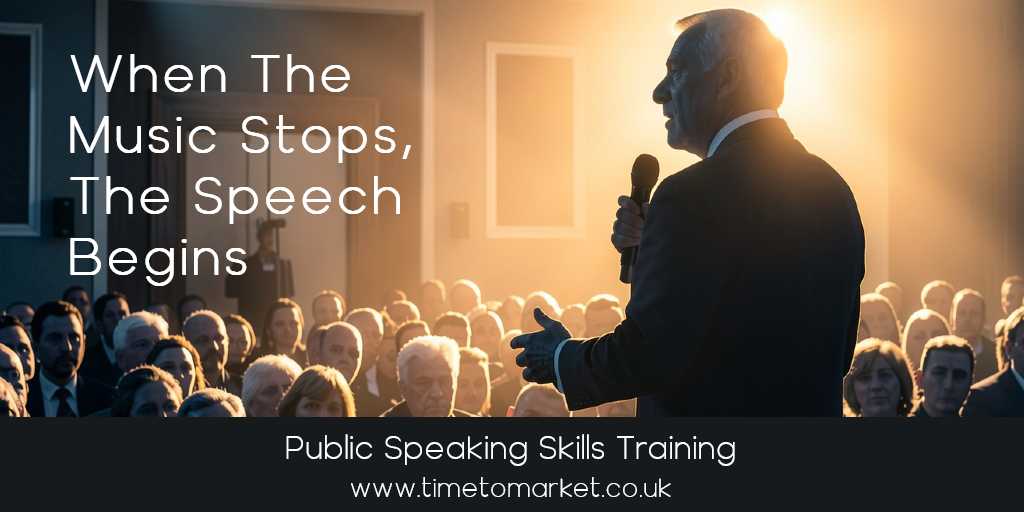
When the Music Stops, the Speech Begins
The Speech Begins with these Pointers
1. Honour
The first job of any anniversary speech is to acknowledge the weight of the occasion explicitly. Don't assume the room feels it — say it. Reagan's speechwriter Peggy Noonan, who you may recall from our earlier post on speechwriter inspiration and the Challenger address, understood this instinctively. When Reagan stood at Pointe du Hoc in Normandy in June 1984 to mark the 40th anniversary of D-Day, the speech opened by locating the audience inside history: "We're here to mark that day in history when the Allied armies joined in battle to reclaim this continent to liberty." No throat-clearing. No warm-up. The occasion was named and honoured in the first breath.
2. Personalise
Abstract history doesn't move people. Human stories do. At Pointe du Hoc, Reagan didn't speak about the D-Day landings in general terms — he spoke directly to the surviving Rangers sitting in front of him. He named them. He described what they had done on that cliff forty years earlier. The moment became personal because he made it personal. When you're marking a significant anniversary — a company milestone, a retirement, a centenary — find the individuals inside the history and bring them forward.
On this day in 1984: Reagan spoke at Normandy.
— SpeakUp! (@Time_To_Market) June 6, 2026
"These are the boys of Pointe du Hoc. These are the men who took the cliffs. These are the champions who helped free a continent."
Three lines, same structure. Parallelism that builds with every repetition. @Peggynoonannyc… pic.twitter.com/6qrDGYRPCT
3. Look Both Ways
The best anniversary speeches do two things simultaneously: they honour what was, and they point to what comes next. Lincoln's Gettysburg Address — still the model for brevity and purpose at a commemorative occasion — spent barely a sentence on the battle itself. The rest was a charge to the living. When you speak at a milestone, your audience doesn't just want to be reminded of the past. They want to know what it means for them now.
4. Find the Line
Every great occasion speech contains one line that outlasts it. "We shall meet again." "The better angels of our nature." "These are the boys of Pointe du Hoc." These weren't accidents. They were crafted, placed, and delivered with intent. When you're preparing a significant speech, ask yourself: what is the one line I want people to leave with? Then build towards it.
5. Don't Outsource the Emotion
Music, video tributes, and montages are supplements. They are not substitutes. The temptation at big occasions is to let production carry the emotional weight so the speaker doesn't have to. The most memorable anniversary speeches work in the opposite direction: the speaker is the moment. Queen Elizabeth's four-minute broadcast during the COVID nonsense in April 2020 — "We will meet again" — contained no production flourishes. Just a woman at a desk, speaking plainly to a nation frightened by media and government. It is already a piece of history.
6. Earn the Moment
Lincoln spoke for two minutes at Gettysburg. Edward Everett, the celebrated orator who preceded him, spoke for two hours. History remembers one of them. Length is not gravitas. At a significant occasion, the impulse is to say everything — to do justice to the scale of what's being marked. Resist it. The discipline to say less, and to say it precisely, is what separates a speech that endures from one that merely fills the programme. Brevity is best.
Tips to Help You Mark the Occasion as the Speech Begins
Marking the occasion with a good speech isn't just the job of Presidents or Prime Ministers. Every executive will need to face up to such a speech in their career. A retirement speech, a farewell, a key project milestone even! These tips should help.
- 1Honour — name the occasion and its weight from the first sentence.
- 2Personalise — find the human story inside the history.
- 3Look Both Ways — honour the past and charge the future.
- 4Find the Line — know what you want people to leave with.
- 5Don't Outsource the Emotion — be the moment, don't just host it.
- 6Earn the Moment — discipline and brevity outlast grand gestures.
For more public speaking and presentation tips, you'll find our full series of tips on the site, such as how to start your speech. Because, with more than 100 top tips for speakers and anyone who has to give a presentation, there's a tip for everyone. And when you're ready to sharpen your own public speaking skills, please get in touch.
OUR CONTACT DETAILS
Phone Number
01344 859823
Email Address
training@timetomarket.co.uk
Training | Coaching | Online Courses | Seminars | Tips | Podcasts | Videos

