
When Lord Robertson delivered the Edward Heath Memorial Lecture in Salisbury on 14 April, he reached for one of the oldest public speaking tricks in the speaker's kit — and got it exactly right. Having spent the best part of a year leading the British Government's Strategic Defence Review, he summed up his conclusions in four short hammer blows:
"We are under-prepared. We are under insured. We are under attack. We are not safe."
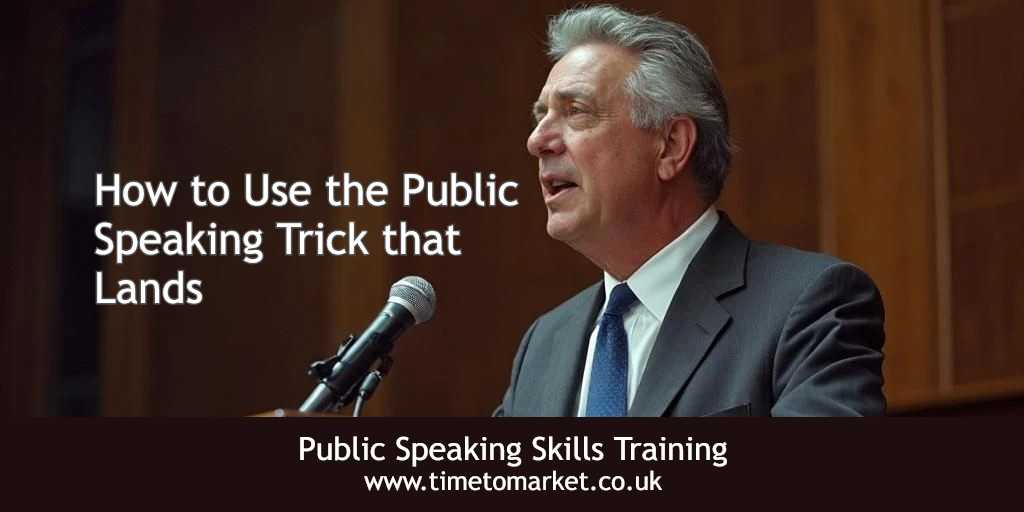
How to Use the Public Speaking Trick That Really lands
That was the line the news bulletins replayed and the commentators reached for. Look closely and you will see a small piece of craft inside it. The first three clauses all open with "We are under…" The fourth breaks the pattern with "We are not safe." Three beats build the rhythm; the fourth snaps it. The audience feels the shift without consciously noticing why the line lands so hard.
Repetition has been doing this job for the best part of three thousand years. So it is worth understanding where the technique came from, who has used it best, and how you can put it to work at your next conference.
A Short History of the Oldest Public Speaking Trick
Repetition predates the written word. Pre-literate cultures leaned on it to make stories memorable — Homer's "rosy-fingered dawn" returns again and again because that is how oral poetry survives the centuries. By the time of ancient Greece and Rome, the technique had been formalised. Aristotle wrote about it in his Rhetoric.
Cicero used it to flatten his opponents in the Senate. The rhetoricians gave it tidy Greek names — anaphora for repetition at the start of successive clauses, epistrophe for repetition at the end.
The King James Bible leaned on it. Shakespeare leaned on it. So roughly 2,500 years of formal pedigree, give or take, and considerably longer if you count the campfire.
Modern Masters
The most quoted example in modern oratory is Martin Luther King's "I have a dream" — eight repetitions in a single passage that still echoes more than sixty years later. Winston Churchill's "we shall fight" sequence at the despatch box in June 1940 did the same job.
Tony Blair's "education, education, education" compressed an entire manifesto into three identical words. President Obama's "yes we can" was a campaign won partly on a refrain. Even Steve Jobs deployed it product launch by product launch with his recurring "and one more thing…" Different stages, different decades, same trick.
So how do you make it work for you at your next event?
Top Tips to Build Repetition
Tip 1
Three. The rule of three is the speaker's best friend. Once is a statement, twice is emphasis, three times is a pattern an audience will feel in their bones. Lord Robertson stretched to four in Salisbury, but only because he engineered a deliberate break on the fourth beat. For most speakers, three is the safer mark — and the safer the better when the line has to land first time.
Tip 2
Land. Reserve repetition for the line you most want remembered. Scatter it through every paragraph and it loses its punch. Identify the single sentence that captures your argument and let the structure carry it home.
Tip 3
Short. Keep the repeated phrase crisp. "I have a dream" is four words. "Yes we can" is three. "Education, education, education" is one. Lord Robertson's clauses run to four words apiece. The shorter the unit, the harder it hits — and the easier it is for the audience to anticipate the next beat.
Tip 4
Pause. Leave a beat between each repetition. The silence is what gives the words room to breathe. Read King's "Dream" passage out loud, or Robertson's four clauses, and you will hear the gaps as clearly as the words.
Tip 5
Earn. Don't bolt repetition onto a flat argument. The technique works because the listener feels the rhythm rising out of the meaning, not imposed on top of it. Build the case first; let the structure emerge and match your message against the what the audience expects.
Tip 6
Vary. Most repetition lives at the start of a clause (anaphora). Occasionally — and only occasionally — repeat at the end instead, as Abraham Lincoln did with "of the people, by the people, for the people." A subtler variation is the deliberate pattern-break: Robertson's three "we are under" clauses set up the rhythm and "we are not safe" snapped it, which is exactly why the audience felt the line land.
A 2,500-year-old technique still does the job because human memory has not changed. We remember rhythm. We remember pattern. We remember the sentence we have heard three times far more easily than the one we have heard once.
The Public Speaking Trick that Lands Every Time
Your use of repetition in your speech doesn't have to be hard. These six pointers will make it work for you.
- 1Three times is the sweet spot — pattern, not padding.
- 2Land repetition on the line you most want remembered.
- 3Keep the repeated phrase short.
- 4Pause between each beat.
- 5Earn the rhythm — let it grow out of your argument.
- 6Vary the position, or break the pattern, for fresh impact.
For more public speaking tips, you'll find our full series on the site. Because with more than 100 top tips for speakers and presenters, there's a tip for every event. And when you're ready to sharpen your own public speaking skills, you're welcome to enroll on an online public speaking course.
OUR CONTACT DETAILS
Phone Number
01344 859823
Email Address
training@timetomarket.co.uk
Training | Coaching | Online Courses | Seminars | Tips | Podcasts | Videos

