
Budget Day is one of the few days in the political calendar when a single speech holds the whole country's attention. On Wednesday 28 October 2026 it comes with a few firsts. It is John Healey's first Budget as Chancellor, after Andy Burnham appointed him in July in place of Rachel Reeves. It is the earliest Autumn Budget since 2021. And Healey is reported to have brought Ministry of Defence-style security into the Treasury to stop the leaks that plagued his predecessor's last Budget.
That makes this a rare Budget where the contents might genuinely stay secret until the Chancellor is on his feet. For anyone who gives speeches, that is worth watching in its own right.
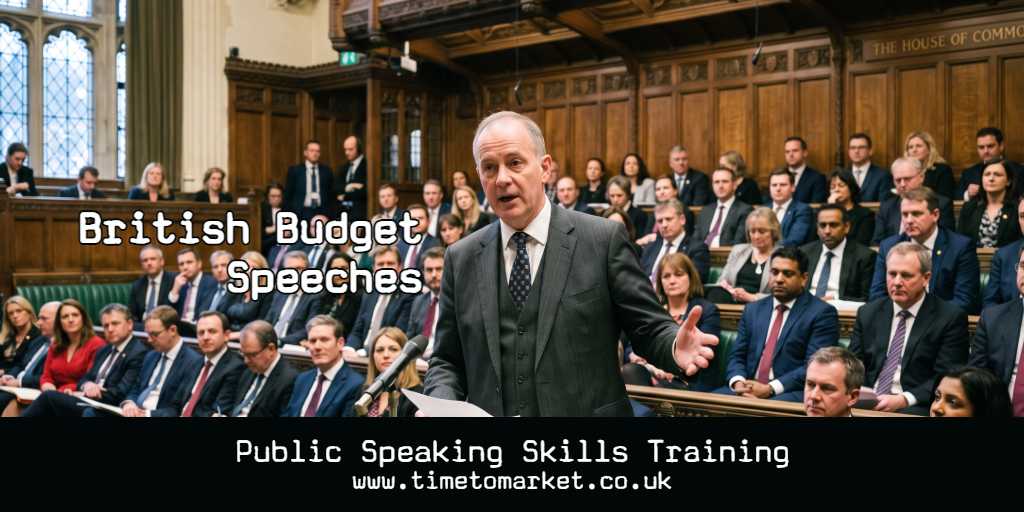
A British Budget Speech Tradition
Budget Day 2026: What to Watch For
Whatever the policy, a Budget speech is also a piece of public speaking, and a very traditional one. Here is what we will be looking at:
Two Healeys at Number 11
Commentators have noted that John Healey is the second former defence secretary named Healey to hold the Chancellor's job. The first, Denis Healey, served as Chancellor from 1974 to 1979, and he followed a long Budget tradition of brandy and water at the despatch box. Whether John Healey follows him with anything stronger than water is one of the small, human questions every Budget Day brings.
Budget Speeches and Their Oddities
Britain has long had a preoccupation with its Budget speeches, and the history is full of quirks.
A Temporary Tax
The annual Budget statement dates back to the eighteenth century. One of its most famous innovations came from William Pitt the Younger, who introduced income tax in 1799 to pay for the war with France. It was meant to be a temporary measure. Temporary?
From Spring to Autumn
Budgets were traditionally held in the spring. In 2017, Philip Hammond moved the main Budget to the autumn, and that has been the pattern since.
The Longest and the Shortest
The longest continuous Budget speech was William Gladstone's on 18 April 1853, which lasted four hours and 45 minutes. He was reportedly sustained by sherry and beaten egg. Benjamin Disraeli holds the record for the shortest, at just 45 minutes in 1867. Disraeli also spoke for around five hours in 1852, although that speech included a break, so the record for longest continuous speech stays with Gladstone.
The Red Box
The famous red Budget box was made for Gladstone around 1860 and was used by Chancellors for 150 years. It was officially retired in 2010 because it was so fragile. Along the way a few Chancellors broke with tradition: James Callaghan used a new box in 1965, and Gordon Brown did the same in 1997. The box carries the Chancellor's speech and notes, not the Budget itself. Its symbolism matters as much as its contents, and the photograph on the steps of Downing Street is as much a part of the day as the speech.
The Chancellor's Tipple
By tradition, the Chancellor is the only person allowed an alcoholic drink at the despatch box, which is otherwise banned in the Commons chamber. Gladstone had sherry and beaten egg, Disraeli brandy and water, Geoffrey Howe gin and tonic, Nigel Lawson a spritzer and Kenneth Clarke whisky. Clarke was the last Chancellor to take alcohol, in 1996. Since then, Chancellors including Gordon Brown, Alistair Darling and George Osborne have chosen mineral water. In 2022, Jeremy Hunt joked that he sadly would not be drinking any whisky as he spoke.
Left at Home
Even Chancellors forget things. In the late 1860s, the heavyweight Chancellor George Ward Hunt arrived at the Commons, opened his box and found he had left his speech at home. Norman Lamont's box once held a bottle of whisky instead of the speech, which was carried in a plastic bag by his aide, a young William Hague. And Geoffrey Howe was so fond of the job that he named his dog Budget.
Five Speaking Lessons from Budget Speeches
You may never present to the House of Commons, but the same principles apply to any important speech or presentation
- 1Protect your surprise. A Budget works best when the audience has not already read the headlines. If you have a key announcement, do not let it leak into the pre-meeting email or an early slide.
- 2Know your length. Gladstone needed four hours and 45 minutes, and Disraeli made his point in 45 minutes. Audiences rarely give extra credit for time.
- 3Use a symbol. The red box is a prop that tells the audience this is the big day. A simple object or image can make your own message instantly recognisable.
- 4Plan for the response. Budget speeches are cheered, jeered and interrupted. Prepare for how your audience will react, including where you will pause for applause and how you will recover if they do not give it.
- 5Check your notes before you leave. George Ward Hunt shows what happens when the speech is not in the box. Check your slides, notes and equipment before you go in. Because this father of the Bride left his speech behind. Twice.
Kenneth Clarke's reflection on one of his Budgets shows what a good response feels like:
“I got a tremendous reaction to the end of the speech. People were waving order papers and cheering; I kept pinching myself. I think I produced the budget which had raised more taxation than any other in living memory, so I had to wonder whether they’d been listening to it!”
Kenneth Clarke, Chancellor of the Exchequer
A Budget speech is typically not theatrical, but it is thorough. It is also a rare moment when the Chancellor takes the limelight. Geoffrey Howe, Chancellor from 1979 to 1983, was known for staying in the background until his resignation speech in 1990 effectively brought down Margaret Thatcher. It was a reminder that a well-judged speech can change a career.
About Time to Market Public Speaking Courses
Time to Market provides first class public speaking training courses from a national network of public speaking training centres. Courses cater for the training needs of a range of public, private and third sector organisations. Boost your public speaking skills today.
Contact Details
Please don't hesitate to get in touch for public speaking course advice.
Phone number
01344 859823
Email Address
training@timetomarket.co.uk
